
Brazil has 49 kite spots with 136 schools listed on kitesurfing.me. Beginner courses average R$295 per hour, the mean of 34 schools' cheapest comparable hourly rate; the most common course is R$2848 (~€484)/10h.
Source: schools' own published rates · updated November 2026.
Book kitesurfing in Brazil
Kitesurfing lessons in Icaraizinho
Pick a course, choose your dates and send it straight to the school. Nothing to pay today.
Kitesurfing in Brazil at a glance
Kitesurfing in Brazil is most dependable from August to November along Ceará’s northeast coast, where Cumbuco, Ilha do Guajiru and Preá offer different water for learners and experienced riders. Start near Fortaleza for easy access, choose Itarema for sheltered lagoon practice, or head to Preá for open ocean. São Miguel do Gostoso in Rio Grande do Norte and Araruama in Rio de Janeiro state make distinct alternatives. Kitesurfing.me lists 136 schools teaching the sport in Brazil, including 23 in Cumbuco and 16 in Preá. Allow time for transfers, tide-dependent launches and lessons suited to your experience.
Brazil has about 7,500 km of Atlantic coastline, with destinations spread across several regions. Rio de Janeiro, São Paulo, Florianópolis and Ilhéus are useful gateways for mainland itineraries, while Fernando de Noronha has its own airport. Distances are large, so trips spanning regions often involve domestic flights and onward road transfers.
- Cumbuco is a practical first base near Fortaleza, with ocean riding and nearby lagoon water.
- Itarema provides access to the tide-dependent flat water of Ilha do Guajiru.
- Preá offers an exposed ocean beach, while Jericoacoara is a village base for nearby riding.
- São Miguel do Gostoso extends the northeast itinerary into the southern summer.
- Araruama offers lagoon riding on a separate Rio de Janeiro state itinerary.
When is the best time for kitesurfing in Brazil?
August to November is the main planning window for Ceará, with July an earlier option. Preá and Atins are options into December, while São Miguel do Gostoso can be useful through February. Araruama’s lagoon season generally runs from September to March. Long-term station measurements show monthly mean wind ranging from 8.3 to 15.9 knots at Cumbuco and 6.1 to 14.7 knots at Jericoacoara, not the wind expected on a particular day.
| Spot | Jan | Feb | Mar | Apr | May | Jun | Jul | Aug | Sep | Oct | Nov | Dec |
|---|---|---|---|---|---|---|---|---|---|---|---|---|
| Cumbuco | ||||||||||||
| Preá | ||||||||||||
| Itarema | ||||||||||||
| Jericoacoara | ||||||||||||
| Amontada | ||||||||||||
| Barreirinhas | ||||||||||||
| Araruama | ||||||||||||
| Icaraízinho de Amontada | ||||||||||||
| Camocim | ||||||||||||
| São Miguel do Gostoso | ||||||||||||
| São Gonçalo do Amarante | ||||||||||||
| Acaraú | ||||||||||||
| Tatajuba | ||||||||||||
| Fortaleza | ||||||||||||
| Barra do Cunhau | ||||||||||||
| Taíba | ||||||||||||
| Ilha do Guajiru | ||||||||||||
| Atins | ||||||||||||
| Barra Grande, Piauí | ||||||||||||
| Lagoa do Cauípe | ||||||||||||
| Guriú |
| Spot | Jan | Feb | Mar | Apr | May | Jun | Jul | Aug | Sep | Oct | Nov | Dec |
|---|---|---|---|---|---|---|---|---|---|---|---|---|
| Cumbuco: wind (kn) | 12 | 10 | 9 | 8 | 9 | 11 | 11 | 14 | 16 | 16 | 15 | 14 |
| Cumbuco: water (°C) | 28 | 29 | 29 | 29 | 29 | 28 | 27 | 27 | 27 | 27 | 28 | 28 |
| Jericoacoara: wind (kn) | 12 | 11 | 9 | 7 | 6 | 7 | 10 | 13 | 15 | 14 | 14 | 12 |
| Jericoacoara: water (°C) | 28 | 29 | 29 | 29 | 29 | 28 | 28 | 27 | 27 | 27 | 28 | 28 |
The best spots for kitesurfing in Brazil
| Spot | Water | Level | Best months | Why go |
|---|---|---|---|---|
| Cumbuco | Ocean chop and flat lagoon | Beginner to advanced | Aug to Nov | Cumbuco combines a village base near Fortaleza with a choppy ocean beach and access to flatter water at Cauípe. There are 23 schools listed here. Beginners can arrange instruction, while freestyle riders should allow for crowding and limited launch space at the lagoon. |
| Preá | Open ocean, chop and waves | Beginner with instruction to advanced | Aug to Nov | Preá’s exposed Atlantic beach offers open-water riding with chop and waves, making it a good choice for independent riders who enjoy space. The 16 schools listed here also serve learners. Agree on the teaching area, beach traffic and rescue arrangements before launching. |
| Itarema | Sheltered lagoon, mostly flat | Beginner to advanced | Aug to Nov | Itarema is the municipality for Ilha do Guajiru, where sheltered lagoon water attracts learners and freestyle riders. Ten schools are listed in Itarema. Tides change the usable depth and access, so plan lesson times around the chosen launch. |
| Jericoacoara | Nearby lagoons and ocean | Beginner with guidance to advanced | Aug to Nov | Jericoacoara offers a village base among dunes, with Preá and other riding areas reached by transfer. Eight schools are listed here. The village waterfront is not a substitute for choosing an appropriate launch, so check park rules, tides and transport with a local operator. |
| Amontada | Ocean and river mouth | Beginner with guidance to advanced | Aug to Nov | Amontada is the municipality that includes Icaraízinho, a coastal base for Atlantic sessions and nearby river-mouth water. Seven schools are listed under Amontada. Choose the actual beach before arranging a transfer, and check tide and launch access with a local operator. |
| Barreirinhas | Nearby river mouth and ocean | Intermediate with local support | Aug to Nov | Barreirinhas is an inland gateway to Atins and Lençóis Maranhenses, with five schools listed here. Plan onward transport to the coast for river-mouth or ocean riding. Within the national park, confirm the permitted riding area and access arrangements before setting out. |
| Araruama | Saline lagoon | Beginner to advanced | Sep to Mar | Araruama, in Rio de Janeiro state, offers a large saline lagoon on a separate itinerary from Ceará. Five schools are listed here. Its flatter water appeals to learners and freestyle riders, but the lagoon has several access points, so agree on the exact launch and check its depth. |
| Icaraízinho de Amontada | Ocean chop and river mouth | Beginner to advanced | Aug to Nov | Icaraízinho de Amontada combines a village beach with ocean chop, waves and river-mouth riding nearby. Five schools are listed here, including Todos Al Agua Icaraizinho, which offers lessons. Ask where instruction takes place and how tide affects the chosen teaching area. |
| Camocim | Ocean and river mouth | Intermediate with local guidance | Aug to Nov | Camocim is a western Ceará base for ocean and river-mouth sessions, with four schools listed here. Independent riders can use it to explore beyond Jericoacoara. Arrange local transport and agree on the tide, landing point and support before an estuary session or downwind trip. |
| São Miguel do Gostoso | Nearshore water and outer waves | Beginner to advanced | Sep to Feb | São Miguel do Gostoso, in Rio Grande do Norte, has a long ocean beach and a season that can extend into February. Four schools are listed here. Learners can arrange lessons, while experienced riders can explore farther offshore where waves form. |
| São Gonçalo do Amarante | Lagoon and open ocean | Beginner with guidance to advanced | Aug to Nov | São Gonçalo do Amarante includes Taíba, where a lagoon and an exposed ocean beach offer different sessions from one village. Four schools are listed in the municipality. Check lagoon depth, crowding and launch space before choosing it for flat-water practice. |
| Acaraú | Coastal and estuary conditions | Intermediate with local guidance | Aug to Nov | Acaraú is a municipality on Ceará’s western coast, with coastal and estuary water and three schools listed here. It suits riders prepared to arrange local transport and identify a specific launch. Check the tide and access before choosing an estuary session. |
| Tatajuba | Lagoon and open coast | Beginner with support to advanced | Aug to Nov | Tatajuba, west of Jericoacoara, combines a dune landscape and lagoon water with an open Atlantic coast. Its remote setting suits travelers with transport and support arranged. Check water levels, access and the landing point before a lagoon session or downwind trip. |
| Fortaleza | Ocean waves and river mouth | Beginner with guidance to advanced | Aug to Nov | Fortaleza is both Ceará’s air gateway and a city riding base. Praia do Futuro has Atlantic waves, while Barra do Ceará is another local kitesurfing area. Choose a launch with local guidance, keep clear of other beach users and arrange instruction if you are learning. |
| Barra do Cunhau | River mouth and ocean | Beginner with guidance to advanced | Sep to Jan | Barra do Cunhau, in Rio Grande do Norte, offers a river mouth alongside an Atlantic beach. The sheltered water can suit progressing riders, while the ocean adds exposure. Tide and the river entrance affect the session, so select an access point with local guidance. |
| Taíba | Lagoon and ocean | Beginner with guidance to advanced | Aug to Nov | Taíba, in São Gonçalo do Amarante, is a village base for both lagoon freestyle and exposed ocean riding. Learners should check available space and depth at the lagoon, then arrange instruction at an area suited to their level. |
| Ilha do Guajiru | Sheltered lagoon | Beginner to advanced | Aug to Nov | Ilha do Guajiru, in Itarema, is a sheltered lagoon destination for lessons and freestyle. Its flatter water makes it a useful alternative to Ceará’s open beaches. Tides affect depth and access, so ask when the chosen teaching or launch area has enough water. |
| Atins | River mouth and ocean | Beginner with support to advanced | Aug to Dec | Atins sits at the Preguiças River mouth near Lençóis Maranhenses, with river-mouth and ocean riding for travelers who arrange local support. Reach it via Barreirinhas and check current permitted areas with the park authority before riding inside the national park. |
| Barra Grande, Piauí | Ocean and nearby flat water | Beginner with guidance to advanced | Aug to Nov | Barra Grande in Piauí is a coastal village stop between western Ceará and Maranhão. Riders can use the ocean beach and seek nearby flatter water. Arrange transport along the route and check tide, access and launch space with a local operator. |
| Lagoa do Cauípe | Shallow freshwater lagoon | Beginner to advanced | Aug to Oct | Lagoa do Cauípe, near Cumbuco, offers shallow, flat water used for lessons and freestyle. The lagoon can become crowded, so beginners should agree on a teaching area with an instructor and check the available depth and launch space. |
| Guriú | Lagoon and river mouth | Beginner with support to advanced | Aug to Nov | Guriú, west of Jericoacoara, has a river-mouth and lagoon area on a route used for downwind trips. The shallow water appeals to supported learners and experienced riders. Check the tide, limited launch space and pickup arrangements before setting off. |
Which Brazil spot suits your kitesurfing level?
Complete beginner
Choose instruction at Cumbuco or Ilha do Guajiru. Check crowding at Cauípe and tide-dependent depth at Ilha do Guajiru.
Improving rider
Icaraízinho and Preá offer open-coast practice. Discuss chop, waves and rescue support with a local instructor.
Independent advanced rider
Link Cumbuco, Preá and Tatajuba by road. Arrange support, a landing point and a pickup for every downwind leg.
Flat-water freestyle rider
Try Ilha do Guajiru or Cauípe, allowing for tides at the former and crowding at the latter.
Family with beginner riders
Cumbuco offers a village base and 23 listed schools. Ask about minimum ages, teaching locations and supervision before booking.
Getting to Brazil and between the spots
- Getting to Brazil
- For destinations in Brazil's Rio de Janeiro state, fly to Rio for Rio de Janeiro, Saquarema and Armação dos Búzios, then continue by road. São Paulo is a gateway for Maresias, Florianópolis airport serves the island, and Fernando de Noronha airport serves the archipelago. For Itacaré, fly to Ilhéus and arrange a road transfer or travel via the Ilhéus bus terminal. If travelling with oversized equipment, confirm that the airline and airport transfer can carry the packed bag, including its length and weight. Ask the transfer provider about the vehicle before paying for the flight.
- Airports
- FORFortaleza-Pinto Martins International AirportFor Cumbuco, São Gonçalo do Amarante. Gateway for Cumbuco and the Ceará coast; arrange onward road transport.
- JJDJericoacoara Regional AirportFor Preá, Jericoacoara, Jijoca de Jericoacoara. Serves Preá and Jericoacoara; onward ground transport is needed.
- GIGRio de Janeiro-Galeão International AirportFor Rio de Janeiro. International gateway for Rio de Janeiro and road travel to Saquarema and Búzios.
- GRUSão Paulo/Guarulhos International AirportInternational gateway for São Paulo, road travel to Maresias and domestic connections.
- FLNFlorianópolis-Hercílio Luz International AirportAirport on Santa Catarina Island, serving the Florianópolis area.
- SSASalvador-Deputado Luís Eduardo Magalhães International AirportGateway for Salvador and onward travel in Bahia.
- FENFernando de Noronha AirportThe island airport, reached by domestic flight.
- IOSIlhéus/Bahia-Jorge Amado AirportFor Itacare. Gateway for Itacaré; arrange a road transfer or travel via the Ilhéus bus terminal.
- Between the spots
- In Brazil, road journeys depend on traffic and the starting address. Rio de Janeiro to Saquarema is about 122 km and roughly 2 hours; Rio to Armação dos Búzios is about 170 km and roughly 3 hours. From Ilhéus airport, allow around 1.5 hours by car or transfer to Itacaré via the BA-001. On Florianópolis island and the São Paulo coast, a car or arranged transfer helps reach different beaches. Domestic flights are useful between distant regions.
- Entry and visa
- Entry requirements for Brazil depend on nationality and passport type. British citizens travelling on a full British citizen passport can visit for tourism without a visa for up to 90 days; their passport must be valid for at least six months from arrival. Other travellers should check current Brazilian consular requirements for their nationality before booking.
- Money and costs
- Brazil's currency is the Brazilian real (BRL, symbol R$), subdivided into 100 centavos and issued by the Central Bank of Brazil. Cards and phone payments are widely accepted in cities and tourist towns, but some cash helps for small vendors, buses and transfers. Food and transport prices vary considerably by city and season.
- Climate and water
- Brazil stretches from the equator to well south of the Tropic of Capricorn, so conditions range from tropical in the north to temperate in the south. Around Itacaré in Bahia, historical seasonal water temperatures are 28 to 29°C from January to May and 25 to 26°C in August and September. In Ceará, long-term monthly means at Jericoacoara range from 26.9 to 29°C for water and from 6.1 to 14.7 knots for wind. These historical figures are not forecasts; conditions vary by location and day.
- Safety
- In Brazil, keep valuables and jewellery secure, especially on beaches and in busy cities. Criminals have used dating apps to target visitors, including through drink spiking and theft, and scams can involve requests to carry packages through airports. Avoid political rallies and large crowds. At beaches and waterways, check local conditions, tides, access and emergency arrangements before entering the water; arrange a safe return route when travelling away from your starting point.
Sources for this guide: Maranhão tourism, kitesurfing guide, Ceará tourism, coastal tourism plan, Fortaleza tourism, Praia do Futuro, Federal University of Uberlândia, Ceará coastal tourism research, Brazilian environmental agency, Jericoacoara nautical instruction rules, Brazilian park authority, Lençóis Maranhenses visitor activities, UK government, Brazil entry requirements, Brazilian government, visa service, UK government travel advice: Brazil safety and security, Coastline of Brazil, Climate of Brazil, Brazilian real, Rio de Janeiro to Saquarema by road, Rio de Janeiro to Búzios by road, Ilhéus airport and onward travel to Itacaré, Getting to Jericoacoara: airport and road distances, Ceará tourism: Cumbuco access, Itacaré seasons and water temperature, Windfinder, station Cumbuco Beach (2013–2026), seatemperature.info, 10-year average, Windfinder, station Jericoacoara (2005–2015), seatemperature.info, 10-year average · Last checked November 2026.
Kitesurfing in Brazil: when and where
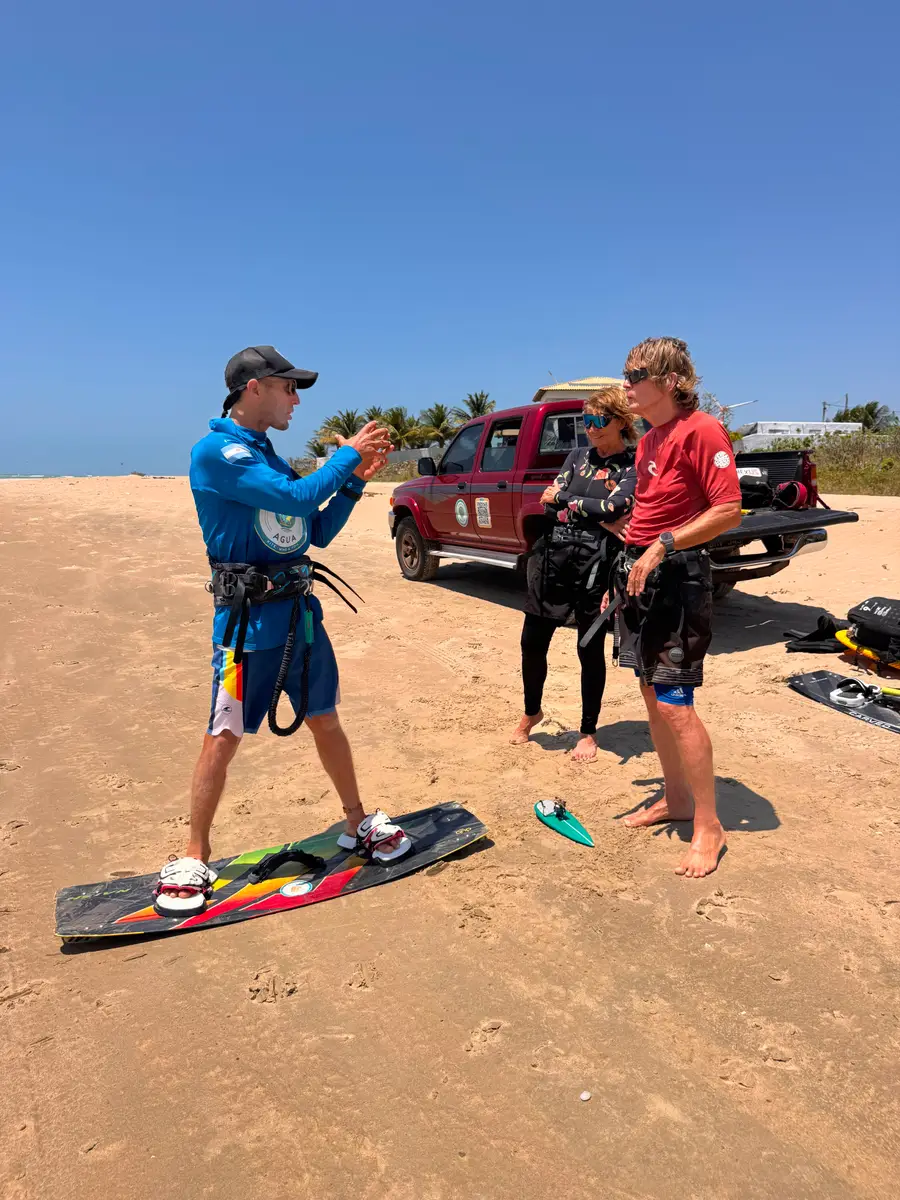
Kitesurfing in Icaraízinho de Amontada, Brazil, offers lessons for beginners and varied water for independent riders who can manage tides and changing wind angles. The curved bay has shallow sections at low tide, chop at higher water and waves near its points. Nearby Moitas, Patos and Caetanos offer day trips. Kitesurfing.me lists 5 schools teaching here. A listed 2-hour private lesson costs 700 BRL.
The main kitesurfing season runs from July to January, with August to November commonly identified as the strongest period. See the season guide for a month-by-month breakdown.
The full Icaraizinho guide: wind by month, beaches, getting there →
Todos Al Agua Icaraizinho: courses, team and photos →
Kitesurfing in Brazil: common questions
When should I kitesurf in Brazil?
August to November is the main window for a Ceará kitesurfing trip in Brazil. July is an earlier option, and Preá and Atins remain options in December. São Miguel do Gostoso can be useful through February, while Araruama generally has a September-to-March lagoon season. Leave spare days around lessons and transfers.
Where can I book kite lessons in Brazil?
On kitesurfing.me you send a booking request with nothing to pay today; the school confirms your dates and you pay at the school: lessons with Todos Al Agua Icaraizinho in Icaraizinho. Other kite spots in Brazil: Preá, Cumbuco, Jericoacoara, Itarema, Amontada, Araruama, Barreirinhas, Itacaré, Paraty, São Gonçalo do Amarante, São Miguel do Gostoso, Camocim, Fortaleza, Jijoca de Jericoacoara, Acaraú, Barra do Cunhau, Salvador, Tatajuba, Rio de Janeiro, Florianópolis, Armacao dos Buzios, Cajueiro da Praia, Lagoinha, Niterói, Taiba, Tibau do Sul, Aquiraz, Aracati, Atins, Barra de Sao Miguel, Barra Grande, Barra Nova, Barrinha de Baixo, Beberibe, Brasília, Guajiru, Imbituba, João Pessoa, Lauro de Freitas, Luís Correia, Natal, Parajuru, Pirangi do Norte, Recife, São Luís, São Sebastião, Trairi, Vitória.
How much does a kite lesson cost in Brazil?
In Icaraizinho, Todos Al Agua Icaraizinho starts at R$700 per person: Private Kitesurf Lesson from R$700.
How do I get to Icaraizinho?
Fortaleza airport is about 200 km from Icaraízinho de Amontada by road, mainly via the CE-085. Arrange a private transfer, taxi or rental car, and tell the driver in advance if you have a kite bag.
Where is the best place for kitesurfing in Brazil?
Cumbuco is a practical first choice for kitesurfing in Brazil, especially for a first trip through Fortaleza. Its ocean beach and nearby Cauípe lagoon offer different conditions. Choose Ilha do Guajiru for sheltered lagoon practice or Preá for open water, and consider tides, crowding and instruction before choosing a launch.
Which country is best for learning kitesurfing, and is Brazil a good choice?
Brazil is a strong choice for learning kitesurfing, with sheltered water and instruction available at places such as Ilha do Guajiru. Cumbuco also offers access to flatter water at Cauípe. No single country suits every learner: ask about teaching depth, launch crowding, equipment and rescue support before booking.
How risky is kitesurfing in Brazil?
Kitesurfing in Brazil carries risks from strong wind, waves, crowded launches, tides and separation from shore. Beginners should take lessons and agree on rescue arrangements. At Ilha do Guajiru, check the tide; for a Ceará downwind trip, arrange support, a clear landing point and transport before leaving.
Which Brazil kitesurfing spots are best for beginners?
Ilha do Guajiru and Cumbuco are useful beginner bases in Brazil when lessons are arranged for the conditions. Ilha do Guajiru has sheltered lagoon water, with depth controlled by the tide. Near Cumbuco, Cauípe is flatter than the ocean but can be crowded. Ask where the instructor teaches.
Where should I kitesurf in Brazil in December?
Preá, Atins and São Miguel do Gostoso are useful Brazil options for a December kitesurfing trip. Preá offers open ocean, Atins combines a river mouth with coastal riding, and São Miguel do Gostoso has a season that can continue into February. Build spare days into the itinerary and arrange onward transport early.
How do I travel between Brazil’s kitesurfing spots with gear?
Fly into Fortaleza airport, FOR, for Cumbuco and a westbound Ceará itinerary, or use Jericoacoara airport, JJD, for Preá and Jericoacoara. Continue by road and arrange a suitable vehicle for sandy sections. For Atins, plan onward transport from Barreirinhas. Check airline board-bag allowances and vehicle luggage space before booking.
How do I find kitesurfing classes near me in Brazil?
Choose the Brazil spot nearest your trip and open its school pages to request lessons for your dates. In Icaraízinho de Amontada, Todos Al Agua Icaraizinho offers instruction. Confirm the teaching beach, your experience level, equipment and safety support before sending a request. The school confirms availability, and you pay at the school.
Do I need a visa for a kitesurfing trip to Brazil?
Brazil’s visa requirements depend on your nationality, passport type and reason for travel. British citizens with a full British citizen passport can generally visit for tourism without a visa for up to 90 days, with at least six months of passport validity from arrival. Check current Brazilian consular guidance for your own passport before booking.
Do I need a wetsuit to kitesurf in northeast Brazil?
Many riders can kitesurf in northeast Brazil wearing swimwear and a rash vest. Long-term monthly water averages range from about 27 to 29°C at Cumbuco and Jericoacoara. A light layer adds sun protection during long lessons. These averages describe the climate, so choose clothing for the conditions during your trip.
What are the kitesurfing access rules near Atins and Jericoacoara?
Kitesurfing inside Lençóis Maranhenses National Park near Atins is limited to authorized areas. Confirm the current riding and access rules with the park authority before setting out. Around Jericoacoara, check the permitted launch areas and park access locally. Commercial kite instruction inside Jericoacoara National Park requires operator authorization.
Where to kite in Brazil
All destinations →Find your place in Brazil.
Pick a spot above, or explore schools across the country by what you want to do.
Explore schools in Brazil