Best Time to Kitesurf in Paje, Zanzibar: Month by Month
When to go kitesurfing in Paje, Zanzibar: the Kaskazi and Kuzi seasons month by month, the tides that decide each session, and what to pack.
The best time to kitesurf in Paje, Zanzibar is June to August or December to February, when the island's two trade winds blow most reliably. Mid-December into March belongs to the Kaskazi; the stronger Kuzi takes over from May or June through October. April and the shoulder weeks around November are the quietest stretches. A trip planned around either season works far better than one planned between them.
How Does Paje's Kite Season Work, Month by Month?
Paje runs on two named trade winds, not one steady system. There is no wind-station history for Paje itself, so the table below groups every month by season instead of a daily reading. June, July, August, December, January and February are the core months; the rest sit on a sliding scale either side of them.
| Month | Wind season | What to expect |
|---|---|---|
| January | Kaskazi | Steady, one of the two best months of the year |
| February | Kaskazi | Steady, one of the two best months of the year |
| March | Kaskazi (tailing off) | Still kiteable, weaker toward month end |
| April | Transition | Weakest month; several guides call it a dead zone |
| May | Kuzi begins (some years) | Sources disagree; can be quiet or already building |
| June | Kuzi | Strong and reliable, a core month |
| July | Kuzi | Strong and reliable, a core month |
| August | Kuzi | Strong and reliable, a core month |
| September | Kuzi (easing) | Still windy most sources agree, less than the peak |
| October | Kuzi (tailing off) | Windy per some guides, weaker per others |
| November | Transition | Short, often weak wind window before the Kaskazi returns |
| December | Kaskazi | New season builds in, one of the two best months |
What Is the Kaskazi Season Like?
The Kaskazi blows from the north from mid-December into March, the lighter of Paje's two trade winds. Speeds commonly run 12-25 knots, averaging 15-18 on a typical day. Mornings stay calm before the wind fills in through the day. That timing coincides with the warmest water of the year, which is why most beginner courses run in this window.
What Is the Kuzi Season Like?
From May or June through October, the Kuzi blows from the south to south-east. This is the stronger of Paje's two winds, covering the same 12-25 knot range but holding more days at the top of it. Riders who already kite independently tend to prefer it. That extra power is steadier, plus it brings small waves at the reef once the tide comes in.
Water Temperature in Paje Through the Year
Water stays warm in the lagoon every month, roughly 26-29°C. Temperatures peak near 29°C in March and April and drop to a still-comfortable 26°C from July to September. That is warm enough that almost nobody kites in a wetsuit here. A rash guard or swim top is as much as most riders bring, whatever month they travel.
How Does the Tide Change the Kiting Day in Paje?
Tide matters as much as the season. At low tide the inner lagoon turns ankle-to-knee deep and nearly flat, the usual lesson window. Around half tide the water is waist deep, widely rated the best few hours of the day. At high tide the water deepens and small waves push toward the beach clubs, better suited to riders who already ride independently.
- Low tide: shallow, nearly flat inner lagoon; where most first lessons happen.
- Half tide: waist-deep, flat water; the best all-round riding window in either season.
- High tide: deeper water and small reef-sheltered waves push up toward the beach clubs; for confident, independent riders.
- Seaweed-farm lines sit inside parts of the lagoon; cross them with care at mid-to-high tide rather than at the lowest water.
Which Months Suit Beginners vs Advanced Riders?
Beginners do best in the Kaskazi, December through February: lighter average wind, the warmest water of the year and schools running their main teaching season. Independent and advanced riders should aim for the Kuzi instead, June through August. That season brings the strongest, most consistent wind and the best chance of small waves at the reef on a high tide. New to the sport? Is kitesurfing hard to learn? covers what to expect before you book.
Packing for a Kite Trip to Paje
Pack light on cold-weather gear and heavy on sun protection. The water never needs a wetsuit here, but the equatorial sun is intense even on a windy day. Reef-safe sandals help on the sandy, uneven lagoon floor. A tide table or app matters more than most forecasts, since it decides your session far more than the knot count does.
- Rash guard or swim top for sun, not cold; a wetsuit is unnecessary in any month here.
- Reef-safe sun protection; the midday sun at this latitude is strong even on an overcast or windy day.
- Sandals or reef shoes for walking out across the lagoon floor and past the seaweed farms.
- A tide-table app for Zanzibar, since it decides your riding window more than the wind forecast alone.
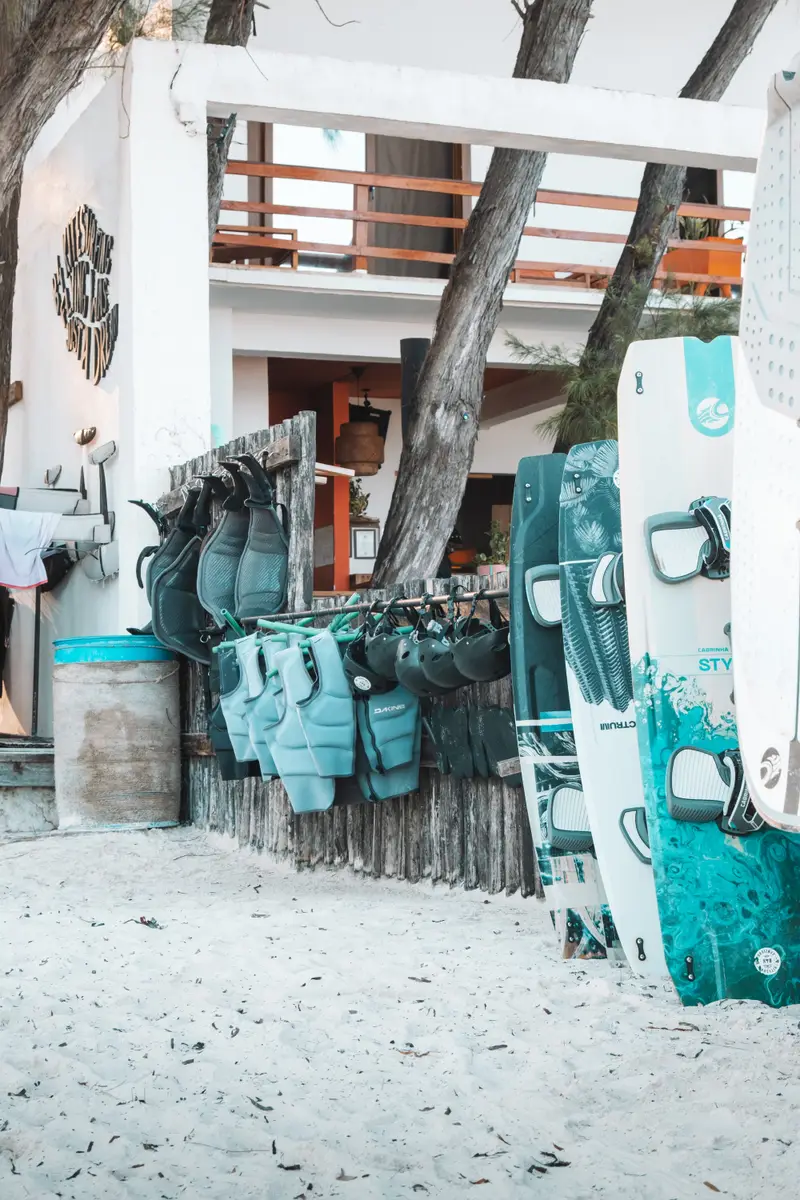
- Your own harness if you already own one; most schools rent the rest, including boards and kites.
What to Do on a Flat or Windless Day
A calm day is not a wasted one in Paje. Dolphins and turtles are regularly seen just offshore, and stand-up paddle tours and downwinders run through the local kite and surf centres. Jozani Forest, home to one of the last wild Red Colobus monkey populations, sits a short drive inland on the main road toward Stone Town.
- Stand-up paddleboarding and SUP downwinders, usually arranged through the kitesurfing or surfing centres on the beach.
- Diving or snorkelling the reef and sandbanks offshore, with a good chance of seeing dolphins or, in season, humpback whales.
- Jozani Forest, a protected reserve and one of the last homes of the Red Colobus monkey, a short drive from Paje.
- A day trip into Stone Town, Zanzibar's old UNESCO-listed quarter, about an hour's drive north.
Which Airport Should You Fly Into?
Abeid Amani Karume International Airport (ZNZ) in Zanzibar Town is the only realistic option, about an hour's drive from Paje down the east-coast road. The wind season does not change which airport you fly into. Book flights around your own travel dates instead, and let the local tide table, not the wind forecast alone, decide your daily session once you land.
Ready to book a lesson? See the full Paje kitesurfing spot guide for every tide window, go straight to B4 Kitesurf Zanzibar's school profile, or read what a lesson in Paje looks like first if this is your first time on a kite.
How Does Paje Fit into Tanzania's Wider Kite Season?
Paje is Tanzania's best-known kitesurfing spot and the one with the most schools, the widest lagoon and the easiest access from the airport. For the country-wide picture, including the other Tanzanian and Zanzibari spots, see our kitesurfing in Tanzania overview.
What is the single best month to kitesurf in Paje?
January, February, July or August: all four sit in the middle of one of Paje's two trade-wind seasons, with steady wind and the schools' main teaching calendar running. January and February suit beginners best, since they fall in the lighter Kaskazi; July and August suit riders chasing the stronger Kuzi.
Can I kitesurf in Paje outside June-August and December-February?
You can try, but April and the shoulder weeks around November are the weakest wind windows, and sources disagree on how reliable May, September and October really are. Accommodation is cheaper and the beach quieter then, which can suit a flexible traveller, but do not plan a fixed-date trip around those months alone.
Do I need to check tide times, not just the wind forecast, in Paje?
Yes. The lagoon only gives flat, shallow water at low tide and deeper water with small waves at high tide, so a school plans your session around the tide table as much as the forecast. Half tide is widely considered the best all-round window for most riders.
Is Paje crowded during the Kaskazi or Kuzi season?
Both main seasons bring more visitors and higher accommodation prices, especially December through February, which overlaps the Christmas and New Year holidays. Book lessons and a place to stay ahead if you are travelling in either peak window.
What should I do in Paje if there is no wind?
Use the day a different way: dive or snorkel the reef offshore, book a stand-up paddle session or downwinder through a local school, or visit Jozani Forest, a protected reserve and one of the last homes of the Red Colobus monkey, a short drive inland.
Do I need a wetsuit for kitesurfing in Paje?
No. Water stays around 26-29°C all year, warmest in March and April and coolest, though still comfortable, from July to September. Almost everyone kites in boardshorts, a swimsuit or a rash guard rather than a wetsuit, whatever month they travel.