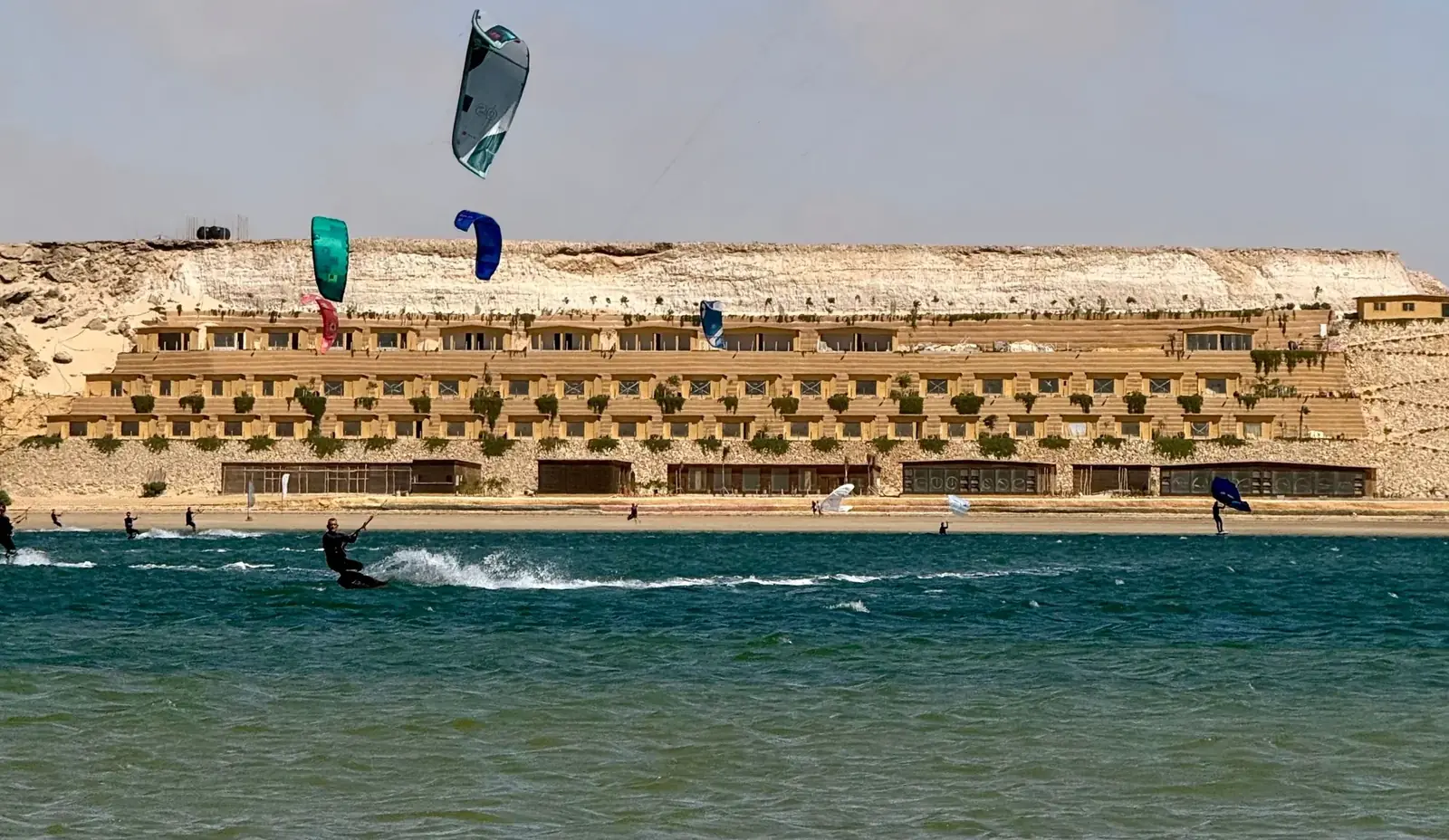
Kitesurfing conditions in Dakhla
Dakhla sits on a narrow peninsula on the Atlantic coast of Western Sahara, a territory administered by Morocco, roughly 1,500 km south of Casablanca and reached via its own small airport (VIL). The peninsula shelters a lagoon over 40 km long, and the spot's whole reputation rests on one thing: an extremely reliable afternoon thermal wind — hot Sahara air rising and pulling cooler Atlantic air in across the water — that blows on 300+ days a year. Combined with the lagoon's flat, shallow water, that wind has made Dakhla one of the most talked-about places in the world to learn or progress in kitesurfing. A short drive away, genuine Atlantic point-break waves (Oum Lbouer, Lassarga) give experienced riders a real wave destination too, once the wind eases into its October–March swell season.
Water: mixedAll levelsBest: Apr, May, Sep, Oct
Wind & season
Dakhla's wind is a single, highly reliable thermal system rather than a two-named-wind setup like Tarifa's Levante/Poniente: hot air rising off the Sahara pulls cooler air in off the Atlantic, building through the morning and blowing steadily — mostly from the north/north-north-east, side-shore across the lagoon — from around midday into the evening. Exact averages vary by source and measuring point: Dakhla Airport's long-term average is 16 knots with average gusts of 32 knots (Windfinder), while lagoon-based trackers cite roughly 12–21 knot averages with single-day gusts up to 35 knots in July–August. The shape is consistent everywhere: light-to-moderate in the shoulder seasons, strongest and gustiest June–September, and 300+ windy days a year overall. June–August is the windiest stretch (25–35 knots, close to daily) but also the hottest and gustiest; April–May and September–October are most often singled out as the best balance of strong, reliable wind with less heat and less crowding. November–March is noticeably lighter for flat-water kiting, but it's the best window for the Atlantic swell at the nearby wave spots.
What makes Dakhla special
- One of the world's most reliable kite destinations: a single, powerful thermal wind system delivers 300+ windy days a year
- A 40+ km flat-water lagoon, shallow and wide enough that it's routinely called one of the best places on Earth to learn or progress
- Real Atlantic point-break waves a short drive away (Oum Lbouer, Lassarga) for experienced wave riders in the October–March swell season — a genuinely different discipline from the lagoon's flat water
- A remote, desert-edge setting on a peninsula in Western Sahara — almost all kiting happens through all-inclusive lagoon kite camps rather than independent town-based schools
- One dominant wind direction (N/NNE, side-shore across the lagoon) rather than Tarifa-style dual winds, so conditions are simple to read but the whole spot depends on that single pattern
Kitesurfing in Dakhla — common questions
What do beginner kitesurfing lessons cost in Dakhla?
11 schools in Dakhla publish a beginner price we can compare; per hour booked they average €47, from €30 to €73, and the most common course is €90/2h. Private lessons average €69 per hour booked, typically €145/2h.
When is the best time to kite in Dakhla?
The best months are Apr, May, Sep, Oct: mean wind 14–18 knots (all hours, calm days included — riding days are windier), water 19–22 °C, so a 4/3 mm wetsuit is usual. Wind measured by Windfinder, station Dakhla Airport (2004–2026).
What are the wind conditions in Dakhla?
Dakhla's wind is a single, highly reliable thermal system rather than a two-named-wind setup like Tarifa's Levante/Poniente: hot air rising off the Sahara pulls cooler air in off the Atlantic, building through the morning and blowing steadily — mostly from the north/north-north-east, side-shore across the lagoon — from around midday into the evening. Exact averages vary by source and measuring point: Dakhla Airport's long-term average is 16 knots with average gusts of 32 knots (Windfinder), while lagoon-based trackers cite roughly 12–21 knot averages with single-day gusts up to 35 knots in July–August. The shape is consistent everywhere: light-to-moderate in the shoulder seasons, strongest and gustiest June–September, and 300+ windy days a year overall. June–August is the windiest stretch (25–35 knots, close to daily) but also the hottest and gustiest; April–May and September–October are most often singled out as the best balance of strong, reliable wind with less heat and less crowding. November–March is noticeably lighter for flat-water kiting, but it's the best window for the Atlantic swell at the nearby wave spots.
Which beach in Dakhla is best for beginners?
Main Lagoon (PK20–PK25) and White Dune (Dune Blanche) and El Argoub are generally the most beginner-friendly beaches in Dakhla.
Are there rules or restricted zones for kitesurfing in Dakhla?
Dakhla doesn't have a Tarifa-style municipal kite ordinance or dated beach-use plan in the sources we could find — the practical 'rules' here are almost entirely about tides, remoteness and the desert climate rather than zoning. The lagoon's satellite spots are tide-dependent: at low tide they can turn either unswimmably shallow, or — at Speed Spot specifically — drop off into deep water with an offshore wind component and real drift risk if you're not confidently riding upwind or don't have a rescue boat on hand, so go with a guide or a booked mini-trip rather than solo. Shuffle your feet in shallow water rather than stepping down hard, a standard local precaution against stingrays and stonefish. The desert setting also means big daily temperature swings — air can reach 35–40°C on a still day and drop sharply after dark — so sun and heat protection matter as much as kite safety.
Where can I learn kitesurfing in Dakhla?
There are 34 kitesurfing schools indexed in Dakhla — prices are pulled from each school's own published rates.
Is equipment rental available in Dakhla?
Yes — full gear rental in Dakhla averages €72 per day across the 16 schools that publish a per-day rate.