
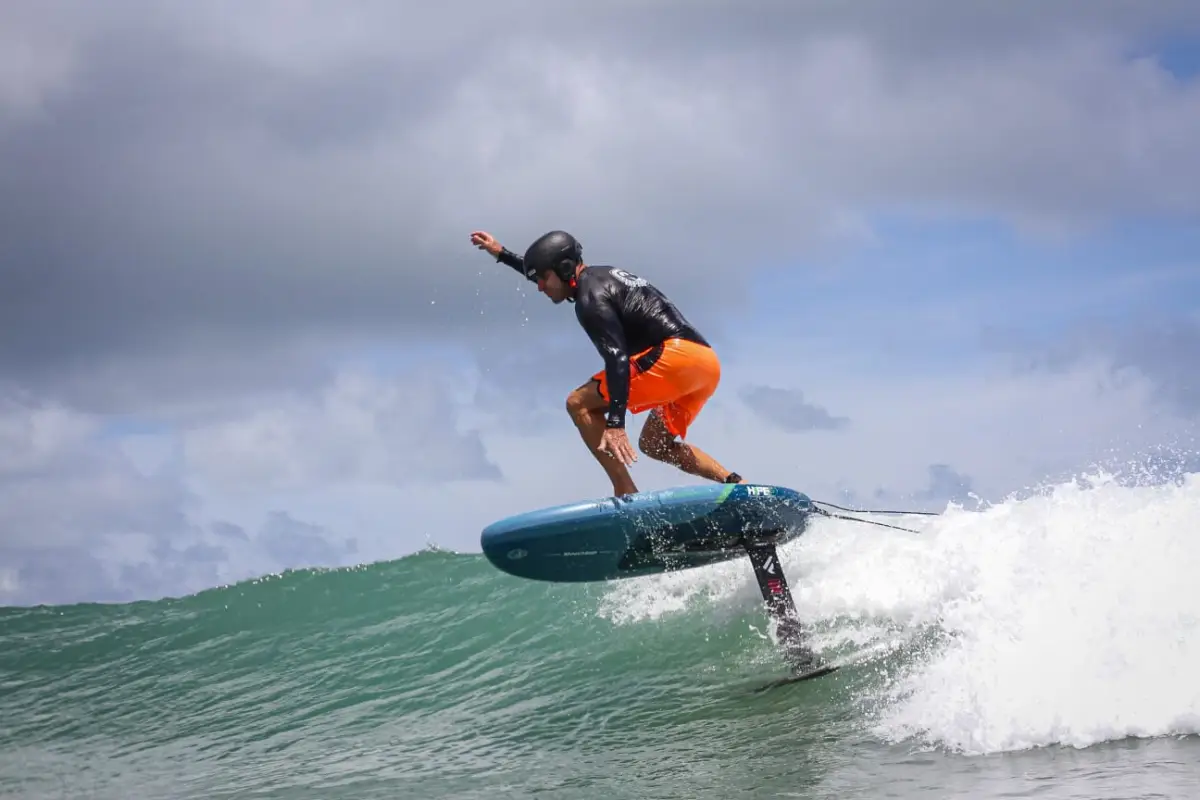
Surf foil in Brazil
1 school in 1 place1 spot guideBest months May to Oct
We list 1 surf foil school in 1 place in Brazil; 1 spot has its own guide below. You can book lessons in Aquiraz (from R$350). Best months: May to Oct.
Book surf foil in Aquiraz
Surf foil lessons in Aquiraz
Pick a course, choose your dates and send it straight to the school. Nothing to pay today.
Surf foil in Brazil at a glance
Surf foiling in Brazil follows the same southeast and south swell as the country's surfing, but needs far less wave to work. The São Paulo coast around Ubatuba, Santos and São Vicente is the best documented area. Brazilian surf foil pioneer Fernando 'Mizo' Novaes calls Santos' Porta do Sol his home spot. Santa Catarina's Ibiraquera has real ocean waves and the Wavegarden Cove pool at the nearby Surfland Brasil resort, offering foiling on demand regardless of swell. In the wind-driven northeast, our partner Dom Foiling School teaches surf foil at Iguape and Prainha in Aquiraz, Ceará, when waves arrive. Instruction is still limited outside these spots, so this is a trip for a self-reliant rider more than a first-timer booking a package.
Brazil has about 7,500 km of Atlantic coastline, with destinations spread across several regions. Rio de Janeiro, São Paulo, Florianópolis and Ilhéus are useful gateways for mainland itineraries, while Fernando de Noronha has its own airport. Distances are large, so trips spanning regions often involve domestic flights and onward road transfers.
- Fernando 'Mizo' Novaes, a Brazilian surf foil pioneer and Brazilian Foil Championship winner, calls Porta do Sol in Santos his home spot
- Ubatuba's Itamambuca beach has had a dedicated surf foil school and stays active enough to host a Circuito Banco do Brasil de Surfe Qualifying Series stage in 2026
- Our partner Dom Foiling School teaches surf foil, alongside wing foil, at Iguape and Prainha in Aquiraz, Ceará, choosing the beach by the day's wind and waves and running lessons year-round
- Near Ibiraquera in Garopaba, Santa Catarina, the Wavegarden Cove pool at Surfland Brasil, opened 2023, has hosted a prone foiling session on a windless day
- São Vicente, on São Paulo's southern coast, was identified in 2017 as one of the state's successful surf foil spots, though no current school is documented there
- A hydrofoil rides waves too small for a surfboard, so Brazil's foil-friendly days likely outnumber its classic surf days, even though conditions have not been rated month by month
When is the best time for surf foil in Brazil?
The biggest, most reliable swells hit the southeast and south from roughly May to October, the same window as conventional surfing at Joaquina and Itamambuca. A hydrofoil needs far less wave than a surfboard to work, so it can ride on days that are too small for surfing. A foiler's practical season on this coast runs wider than a surfer's, including months outside the peak. Ceará's Aquiraz follows its own calendar: our partner there fits surf foil lessons around whenever the swell arrives, rather than one fixed season.
| Spot | Jan | Feb | Mar | Apr | May | Jun | Jul | Aug | Sep | Oct | Nov | Dec |
|---|---|---|---|---|---|---|---|---|---|---|---|---|
| Itamambuca |
The best spots for surf foil in Brazil
| Spot | Water | Level | Best months | Why go |
|---|---|---|---|---|
| Itamambuca | River-mouth & beach break | Beginner lessons, open water | May to Sep | A beach-and-river break on Ubatuba's coast that has had a dedicated surf foil school started by a local surfer, teaching the sport on the same stretch of water that hosted a Circuito Banco do Brasil de Surfe Qualifying Series stage in 2026. |
| São Vicente | Exposed beach break | Open water, self-sufficient | Not specified | On São Paulo's southern coast, São Vicente was identified in 2017 as one of the state's successful surf foil locations, though no current school or instructor is documented; check locally for lessons before planning a trip around this spot alone. |
| Santos (Porta do Sol) | Beach break | Advanced and pro scene | Not specified | Porta do Sol in Santos is the home spot of Fernando 'Mizo' Novaes, a Brazilian surf foil pioneer and Brazilian Foil Championship winner who first tried a SUP foil in 2016; it is a credible place to see the sport ridden at a high level. |
| Ibiraquera / Garopaba | Point/beach break, wave pool | Open water, plus pool option | Not specified | Ibiraquera's point and beach breaks are good enough to host the GWA Wingfoil World Cup's Wave discipline, held there 19-26 October 2024. The nearby Wavegarden Cove pool at the Surfland Brasil resort in Garopaba opened in 2023, and a touring foil team recorded a prone, no-wing foiling session there on a windless day. |
| Aquiraz (Iguape & Prainha) | Beach breaks, wind-dependent | Beginner to advanced | See the spot guide | Our partner Dom Foiling School teaches surf foil, alongside wing foil, at Iguape and Prainha in Aquiraz, Ceará, choosing the beach by the day's wind and sea. Ceará offers good surf foil conditions when waves arrive and good wing foil conditions when the wind picks up. |
Which Brazil spot suits your surf foil level?
Complete beginner, never used a foil
Book an instructor rather than teach yourself: a foil's mast and wing are rigid and can cut on a fall. Dom Foiling School in Aquiraz includes equipment in its lessons. A 2017 estimate for an independent lesson in Ubatuba was around R$300 an hour if you already owned a board, plus a helmet and impact vest.
Surfer who already rides Brazil's southeast coast
The same Itamambuca, São Vicente and Santos beaches you already surf work for foiling on days too small or mushy for a board, since the foil needs far less wave to get moving.
Rider who wants a guaranteed wave regardless of swell
Surfland Brasil's Wavegarden Cove pool near Ibiraquera turns out a wave every few seconds on demand, though a session is tied to staying in the resort's own rooms, not a drop-in lesson.
Traveller drawn to Ceará's wind coast
Our partner Dom Foiling School teaches surf foil at Iguape and Prainha in Aquiraz year-round, choosing the beach for the day's wind and waves. It is a single small operation on a coast better known for wind sports, so confirm current wave conditions with the school before booking around swell alone.
Getting to Brazil and between the spots
- Getting to Brazil
- For destinations in Brazil's Rio de Janeiro state, fly to Rio for Rio de Janeiro, Saquarema and Armação dos Búzios, then continue by road. São Paulo is a gateway for Maresias, Florianópolis airport serves the island, and Fernando de Noronha airport serves the archipelago. For Itacaré, fly to Ilhéus and arrange a road transfer or travel via the Ilhéus bus terminal. If travelling with oversized equipment, confirm that the airline and airport transfer can carry the packed bag, including its length and weight. Ask the transfer provider about the vehicle before paying for the flight.
- Airports
- FORFortaleza-Pinto Martins International AirportFor Cumbuco, Sao Goncalo do Amarante. Gateway for Cumbuco and the Ceará coast; arrange onward road transport.
- JJDJericoacoara Regional AirportFor Prea, Jericoacoara, Jijoca de Jericoacoara. Serves Preá and Jericoacoara; onward ground transport is needed.
- GIGRio de Janeiro-Galeão International AirportFor Rio de Janeiro. International gateway for Rio de Janeiro and road travel to Saquarema and Búzios.
- GRUSão Paulo/Guarulhos International AirportInternational gateway for São Paulo, road travel to Maresias and domestic connections.
- FLNFlorianópolis-Hercílio Luz International AirportAirport on Santa Catarina Island, serving the Florianópolis area.
- SSASalvador-Deputado Luís Eduardo Magalhães International AirportGateway for Salvador and onward travel in Bahia.
- FENFernando de Noronha AirportThe island airport, reached by domestic flight.
- IOSIlhéus/Bahia-Jorge Amado AirportFor Itacare. Gateway for Itacaré; arrange a road transfer or travel via the Ilhéus bus terminal.
- Between the spots
- In Brazil, road journeys depend on traffic and the starting address. Rio de Janeiro to Saquarema is about 122 km and roughly 2 hours; Rio to Armação dos Búzios is about 170 km and roughly 3 hours. From Ilhéus airport, allow around 1.5 hours by car or transfer to Itacaré via the BA-001. On Florianópolis island and the São Paulo coast, a car or arranged transfer helps reach different beaches. Domestic flights are useful between distant regions.
- Entry and visa
- Entry requirements for Brazil depend on nationality and passport type. British citizens travelling on a full British citizen passport can visit for tourism without a visa for up to 90 days; their passport must be valid for at least six months from arrival. Other travellers should check current Brazilian consular requirements for their nationality before booking.
- Money and costs
- Brazil's currency is the Brazilian real (BRL, symbol R$), subdivided into 100 centavos and issued by the Central Bank of Brazil. Cards and phone payments are widely accepted in cities and tourist towns, but some cash helps for small vendors, buses and transfers. Food and transport prices vary considerably by city and season.
- Climate and water
- Brazil stretches from the equator to well south of the Tropic of Capricorn, so conditions range from tropical in the north to temperate in the south. Around Itacaré in Bahia, historical seasonal water temperatures are 28 to 29°C from January to May and 25 to 26°C in August and September. In Ceará, long-term monthly means at Jericoacoara range from 26.9 to 29°C for water and from 6.1 to 14.7 knots for wind. These historical figures are not forecasts; conditions vary by location and day.
- Safety
- In Brazil, keep valuables and jewellery secure, especially on beaches and in busy cities. Criminals have used dating apps to target visitors, including through drink spiking and theft, and scams can involve requests to carry packages through airports. Avoid political rallies and large crowds. At beaches and waterways, check local conditions, tides, access and emergency arrangements before entering the water; arrange a safe return route when travelling away from your starting point.
Surf foil in Brazil: your questions
When is the best time to surf foil in Brazil?
The southeast and south get their biggest, most reliable swell from roughly May to October, the same window that drives conventional surfing at Itamambuca and Joaquina. A foil needs far less wave than a surfboard, though, so smaller swells outside that window, too small for surfing, can still work on the same beaches.
Where should a beginner learn to surf foil in Brazil?
Two realistic options are Itamambuca beach in Ubatuba, São Paulo state, which has had a dedicated surf foil school, and our partner Dom Foiling School in Aquiraz, Ceará. The partner school teaches surf foil from zero at Iguape and Prainha, with equipment included. A 2017 estimate for an independent Ubatuba lesson was around R$300 an hour if you already owned a board.
Can I surf foil in Brazil outside the May-to-October swell season?
Yes, on the same southeast beaches. A hydrofoil needs far less wave than a surfboard, so days that are too small for surfing, common most of the year at Joaquina and Itamambuca, are often still ridable on a foil. For a wave regardless of swell, Surfland Brasil's pool near Ibiraquera runs year-round.
How do I get between Brazil's surf foil spots?
Ubatuba, Santos and São Vicente all sit on São Paulo's coast within about two hours of each other and of Guarulhos airport. Santa Catarina's Ibiraquera and Garopaba are a separate trip through Florianópolis airport (FLN), and Aquiraz is reached through Fortaleza (FOR) on the opposite side of the country, with no road link between any of the three regions.
Do I need a visa to surf foil in Brazil?
It depends on where you are from. Brazil waives tourist visas for up to 90 days for UK and EU travellers, while US, Canadian and Australian passport holders must apply ahead through the official gov.br consular portal. These rules can shift without much warning, so check the current policy for your passport before booking flights.
What does a surf foil lesson cost in Brazil?
Our partner Dom Foiling School in Aquiraz, Ceará, lists a beginner or private surf foil lesson at R$350, about €60, an hour, including equipment. For São Paulo state, the only other documented figure is a 2017 estimate of around R$300 an hour for an independent Ubatuba lesson if you already owned a board. A budget restaurant meal costs around R$35.
Do I need a wetsuit to surf foil in Brazil?
On the São Paulo coast around Itamambuca, sea temperature is roughly 19-22°C in late July and 24-28°C in late February. A spring suit or shorty is worth packing outside summer, with boardshorts and a rash vest enough in warmer months. Santa Catarina's water runs colder again in its own winter.
Is surf foiling safe in Brazil?
The equipment carries its own risk: a foil's mast and wing are rigid and can cause a real injury on a fall. Wear a helmet and impact vest, and start with an instructor. Beyond the gear, beach theft and scams are the main general risks for visitors in Brazil, so keep valuables secure when visiting the coast.
Sources for this guide: F-ONE: Fernando Novaes athlete profile, IstoÉ: Flying boards take over the São Paulo coast (2017), surf-forecast.com: Itamambuca, Maquina do Esporte: Circuito Banco do Brasil de Surfe 2026, Itamambuca stage, surf-forecast.com: Itamambuca sea temperature, surf-forecast.com: Joaquina, Stab Mag: Brazil's third wave pool, Surfland Brasil in Garopaba, Duke Surf: second South American Wavegarden to be in Garopaba, Wave Pool Mag: update on Brazil's wave pool scene, Sail World: GWA Wingfoil World Cup Ibiraquera 2024 preview, Duotone: Hidden Gems, wing foiling across southern Brazil, Tonic Mag: What is Prone Foiling?, UK government travel advice: Brazil entry requirements, UK government travel advice: Brazil safety and security, Numbeo: Cost of living in Brazil, Brazilian government: visa service, Coastline of Brazil, Climate of Brazil, Brazilian real, Rio de Janeiro to Saquarema by road, Rio de Janeiro to Búzios by road, Ilhéus airport and onward travel to Itacaré, Getting to Jericoacoara: airport and road distances, Ceará tourism: Cumbuco access, Itacaré seasons and water temperature · Last checked November 2026.